The Visual Politics of Public Money

Banknotes, Hierarchy, and Legitimacy

Alfredo Hernandez Sanchez

Vilnius University

2026-06-12


[N]ot even love has made so many fools of men as the pondering over the nature of money.

– Gladstone (1845*) according to Marx (1904, 73)

Money and Medium and Message


Banknotes are (at least) three things:

  • An object
  • A contract
  • A symbol


Coin of Alyattes, c. 620/10 – 564/53 BC.

Coin of Alyattes, c. 620/10 – 564/53 BC.


Banknote iconography is a visual narrative of value.

Visual Narrative Framework

  • Banknotes are visual narratives with characters, settings, plots and morals:
    • With symbols we infer the last two based on the first.
  • They communicate some purpose, and may respond to public preferences or guide them.
  • Like other narratives they operate a various levels (Stauffer 2023; Schlaufer et al. 2022; Kuenzler et al. 2025):
    • Micro, Meso, Macro.

Existing literature


Research on currency iconography has shown how banknotes project national identity, collective memory, state formation, design conventions, gender hierarchies, institutional quality, and conservation visibility (Hymans 2004; Penrose 2011; Lawson 2019; Fiori 2025; Newbery, Morrison, and Castley 2024).


A key debate is whether banknote iconographic choices respond to public opinion trends or if they instead are instruments by governments to shape them (state-as-pedagogue) (Helleiner 1998; Lauer 2008; Papadopoulos 2015).

Main Research Question(s)


Does the hierarchical nature of the monetary architecture leave traces on the symbolic surface of public money?

Does the symbolic composition of banknotes shift when issuers experience hard times?

Does the gendered symbolism of banknotes respond to political shifts?

Preliminary Hypotheses

  • Shifts in gendered symbolism correlate with political shifts.
  • Symbolic stability is greater near the apex of the monetary hierarchy.
  • Symbolic volatility increases as we move toward the periphery.
  • Symbolic volatility increases following hard times.
  • Imagined pasts and future shift following hard times.

Data Snapshot

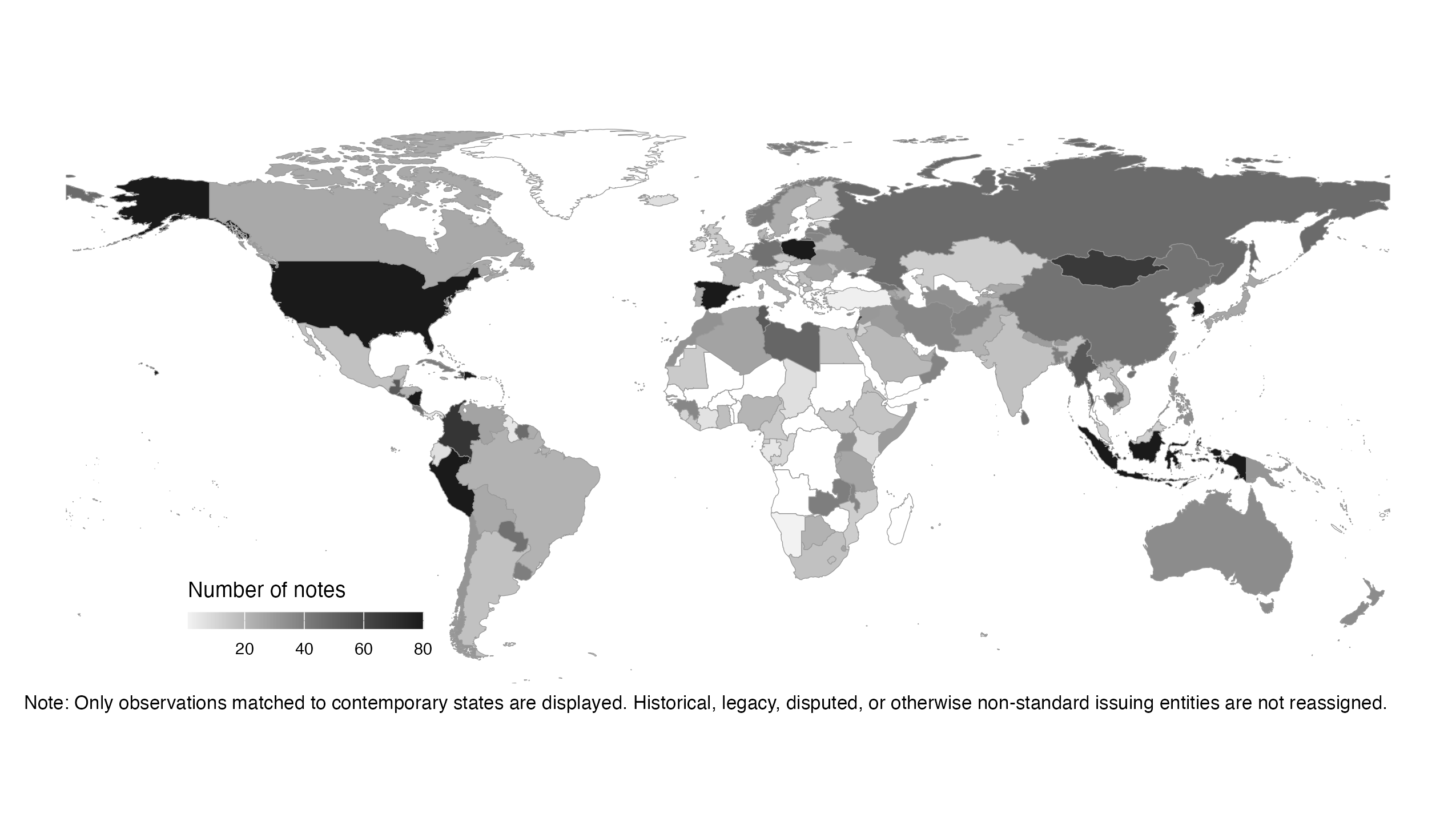
  • The working dataset contains 4,275 banknotes from 151 issuing countries or entities, spanning 1900 to 2026.

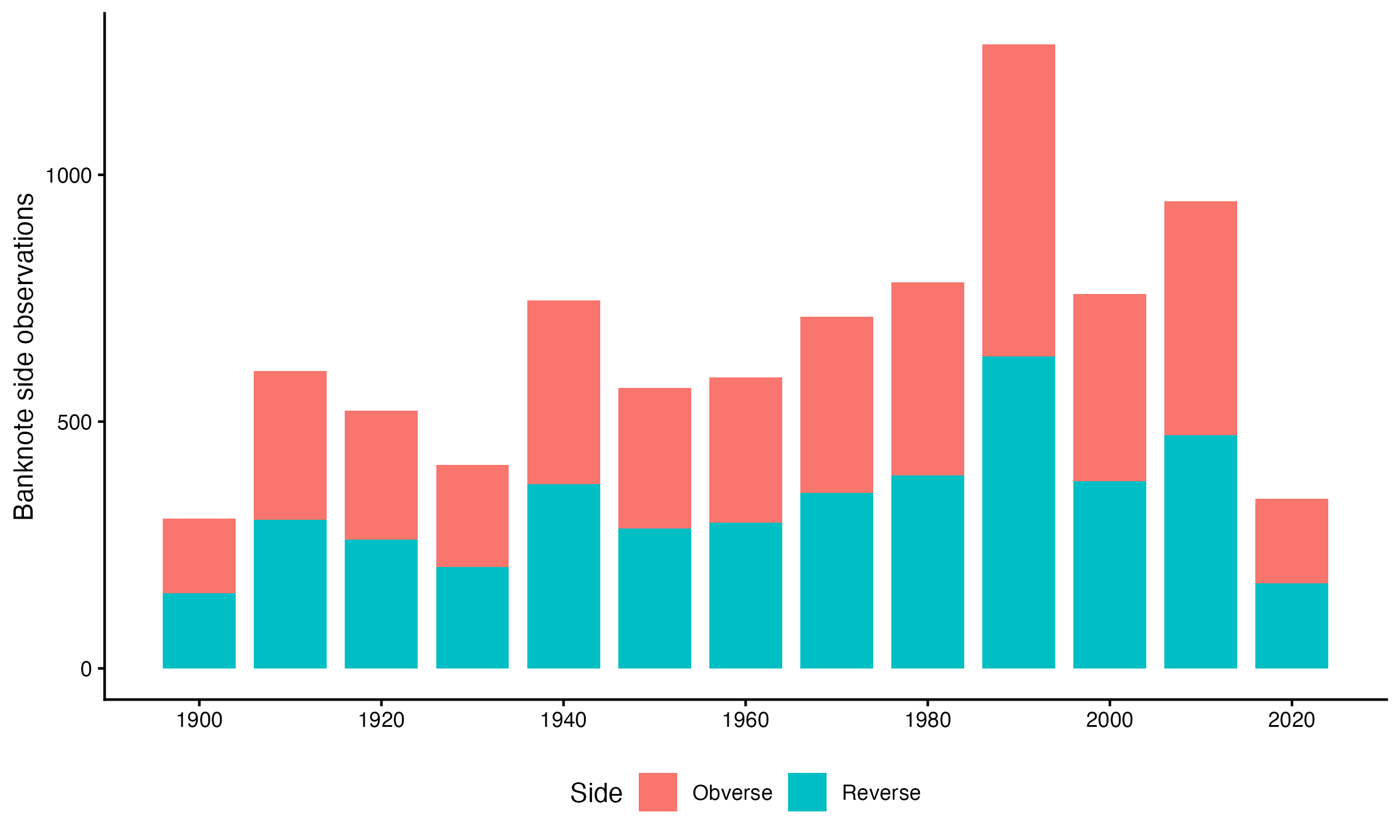
  • Obverse and reverse images are treated separately, yielding 8,550 banknote side images.

  • The classified results currently cover 3,456 high confidence banknote side observations from 74 issuing countries or entities, spanning 1900 to 2025.

  • Classifications below 0.90 confidence are excluded from the preliminary results.

Geographic coverage

Geographic distribution of banknotes in the sample.

Temporal coverage

Banknote side observations in the working sample by decade and side.

Coding strategy

  • The unit of analysis is the banknote side.

  • The model records visible content only. It does not infer national meaning, ideology, political intention, secularism, authoritarianism, modernization, or collective identity from an isolated image.

  • A visible portrait can be coded as a human figure and, when apparent, as male, female, mixed, or unknown. It is not coded as evidence of a political meaning.

Motif families

Analytic family Visible motif variables Main use
Persons Human figures, portraits, apparent gender, collective figures, allegorical figures Tracks who is placed on money and whether people appear as individual, collective, or symbolic subjects.
Authority and institutions Buildings, monuments, heraldic symbols, religious symbols, official emblems Captures visible signs of state, institutional, sacred, or monumental authority.
Territory and nature Landscapes, water, plants, animals Captures land, nature, territory, and non human symbolic life.
Modernity and infrastructure Vehicles, machines, industrial or technological objects Captures development, movement, production, and technical modernization.
Ornament and abstraction Guilloche, borders, decorative engraving, abstract designs, ornamental only sides Provides a contrast category for decorative or non representational design.

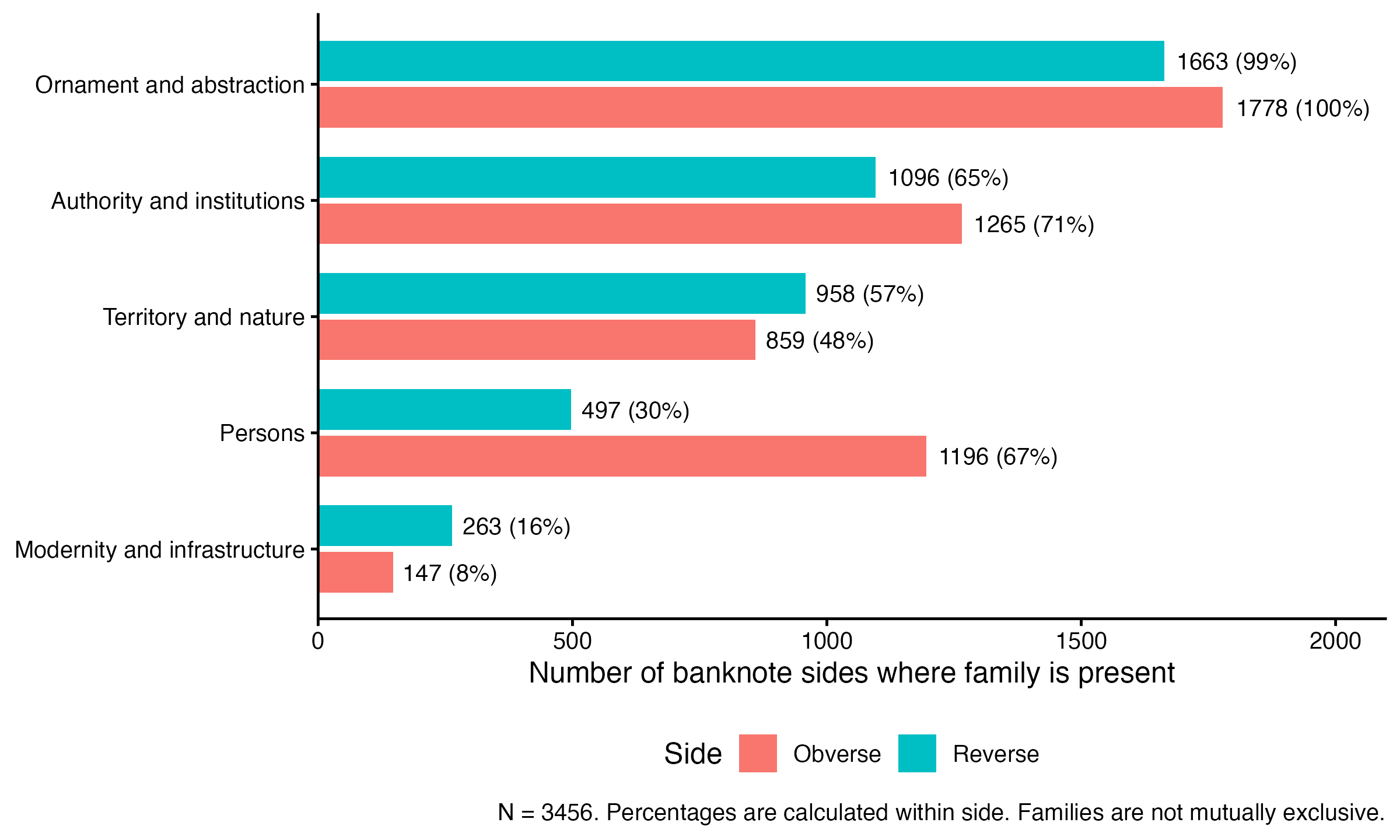
Side Distributions

Distribution of analytic motif families by side.

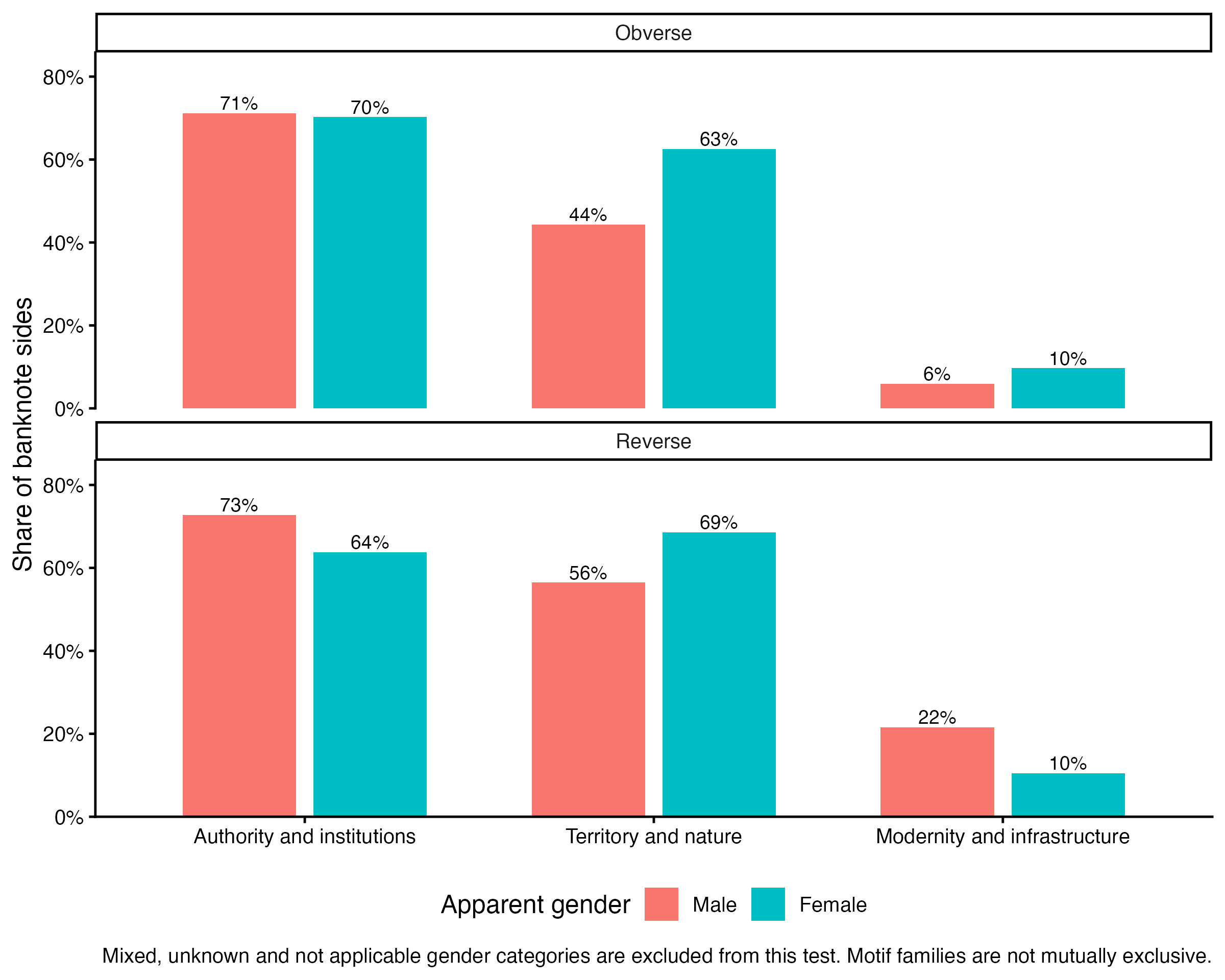
Gendered symbolism

Gendered co-presence of authority and nature motifs.

Allegory and authority markers


Comparison Female Male Difference p value
Female allegory versus authority marker 166 of 404, 41.1 percent versus 72 of 404, 17.8 percent Not used 23.3 percentage points <0.001
Allegory among female versus male coded figures 166 of 404, 41.1 percent 59 of 1000, 5.9 percent 35.2 percentage points <0.001
Authority marker among female versus male coded figures 72 of 404, 17.8 percent 201 of 1000, 20.1 percent negative 2.3 percentage points 0.371

Preliminary Results

  • 1,196 obverse sides, or 67 percent, contain persons. The corresponding figure for reverses is 497 sides, or 30 percent.

  • Authority and institutional motifs are also more common on obverses, appearing on 71 percent of obverses and 65 percent of reverses.

  • Modernity and infrastructure are less common overall, appearing on 16 percent of reverse sides and 8 percent of obverses.

  • On obverses, territory and nature motifs appear with 63 percent of female coded figures and 44 percent of male coded figures. On reverses, the corresponding shares are 69 percent and 56 percent.

Discussion

  • The front of the note tends to carry the more direct signs of authorization and hierarchy.

  • The reverse more often elaborates the territorial, developmental, scenic, or natural environment around that claim.

  • Female coded figures are more often accompanied by territory and nature motifs.

Limitations

  • These results remain preliminary.

  • The classified corpus is incomplete, and the categories that require judgment, especially allegory, authority markers, and apparent gender, still require manual validation.

  • The final analysis needs to test whether the same patterns hold across regions, periods, denominations, and issuer types.

Next steps

  • Manual validation of a stratified sample of banknote sides (app).

  • Category level reliability checks for ambiguous motifs (e.g. past/future).

  • Full principal component analysis (PCA) of symbolic variation over time.

  • Models linking representational roles to monetary hierarchy and broader political economy covariates.

Money as Light Metaphor

  • Money functions as credit and as commoodity, but it also acts as symbol of value:

    • It is an impersonal claim within a social system.

    • It operates under the dual rationalist logics of efficiency and authority.

    • However, the intuitive logic of symbolism, of value and attention, should not be ignored.

Thank you for your attention!

About the FIRSA Project

Disclaimer:

This project has received funding from the European Union Marie Skłodowska-Curie Postdoctoral Fellowships / ERA Fellowships action under grant agreement No. 101180601 under the title: Understanding FinTech Regulatory Sandbox Development in Europe (FIRSA).

Learn more at the project website.

Logo

References

Fiori, Angelamaria. 2025. “Portraits on Banknotes: A Study of the Gender Gap.” SSRN Electronic Journal. https://doi.org/10.2139/ssrn.5246592.
Helleiner, Eric. 1998. “National Currencies and National Identities.” American Behavioral Scientist 41 (10): 1409–36. https://doi.org/10.1177/0002764298041010004.
Hymans, Jacques E. C. 2004. “The Changing Color of Money: European Currency Iconography and Collective Identity.” European Journal of International Relations 10 (1): 5–31. https://doi.org/10.1177/1354066104040567.
Kuenzler, Johanna, Bettina Stauffer, Caroline Schlaufer, Geoboo Song, Aaron Smith-Walter, and Michael D. Jones. 2025. “A Systematic Review of the Narrative Policy Framework: A Future Research Agenda.” Policy & Politics 53 (1): 129–51. https://doi.org/10.1332/03055736Y2024D000000046.
Lauer, Josh. 2008. “Money as Mass Communication: U.s. Paper Currency and the Iconography of Nationalism.” The Communication Review 11 (2): 109–32. https://doi.org/10.1080/10714420802068359.
Lawson, Kerianne. 2019. “Using Currency Iconography to Measure Institutional Quality.” The Quarterly Review of Economics and Finance 72 (May): 73–79. https://doi.org/10.1016/j.qref.2018.10.006.
Marx, Karl. 1904. A Contribution to the Critique of Political Economy. Chicago: Charles H. Kerr & Company.
Newbery, Beaudee, Clare Morrison, and J. Guy Castley. 2024. “From Cash to Conservation: Which Wildlife Species Appear on Banknotes?” People and Nature 6 (5): 1849–64. https://doi.org/10.1002/pan3.10681.
Papadopoulos, Georgios. 2015. “Currency and the Collective Representations of Authority, Nationality, and Value.” Journal of Cultural Economy 8 (4): 521–34. https://doi.org/10.1080/17530350.2014.989884.
Penrose, Jan. 2011. “Designing the Nation. Banknotes, Banal Nationalism and Alternative Conceptions of the State.” Political Geography 30 (8): 429–40. https://doi.org/10.1016/j.polgeo.2011.09.007.
Schlaufer, Caroline, Johanna Kuenzler, Michael D. Jones, and Elizabeth A. Shanahan. 2022. “The Narrative Policy Framework: A Travelers Guide to Policy Stories.” Politische Vierteljahresschrift 63 (2): 249–73. https://doi.org/10.1007/s11615-022-00379-6.
Stauffer, Bettina. 2023. “What’s the Grand Story? A Macro-Narrative Analytical Model and the Case of Swiss Child and Adult Protection Policy.” Policy Studies Journal 51 (1): 33–52. https://doi.org/10.1111/psj.12465.